Sunday, July 29, 2012

Avoid financial ruin - cont.

Take it slow


Rome wasn't built in a day, and neither is an emergency fund. Any action you can take to establish an emergency fund will do you good. If you transfer $10 to a savings account each week, you'll have $500 in a year.
Take it slowDon't be afraid to start with a small amount of savings each month, but try to increase it whenever possible.
When you pay off a credit card with a $50 monthly payment, increase your savings by that $50. With the same outflow you have today, you'll be paying yourself.
When you get a tax refund or commission check, add it to your fund, he says. And gradually boost your savings by selling items you don't need on eBay, holding a yard sale or putting change into a jar every evening.
Save rather than blow your excess money. By stashing the extra, in addition to your regular predetermined amount from your budget, you'll see your savings soar.

Saturday, July 28, 2012

Avoid financial ruin - cont.

Use it only for emergencies
An emergency fund is for the unexpected, according to a Barron's Top 100 financial adviser and the director of consumer education for FreeScore.com. For example, appliances that stop working, getting laid off from a job, a long illness or an accident. You use an emergency fund for any expense you cannot foresee.
One of the most common problems people have with emergency funds is forgetting to plan for one-time expenses each year.
People budget to save and put away an emergency fund, then they forget to budget for an annual insurance expense or car expenses, etc. You can foresee your car insurance expense next November, for example, so it is not an emergency.
One way to avoid using the fund for nonemergencies is to make access to it somewhat difficult. "Do not get access to it via debit card. And if you are issued a checkbook, hide it.

Friday, July 27, 2012

Avoid financial ruin - cont.

Treat it like a bill
Establish a monthly savings goal and make it part of your regular budget. Marquis recommends setting up an automatic monthly transfer, just as you would with the electric bill or fitness club membership, to ensure the money is saved each month.
The forced savings should feel like a bill pay transaction that is done on the same day of every month.
Paying yourself first through a direct deposit from your paycheck into your emergency fund account will help you build your fund steadily. But make sure you've created a balanced budget so you know you have enough money to save.
Too many people direct deposit money in their savings accounts, only to turn around and pull the money back out to pay bills. A solid monthly spending plan can help avoid this situation.

Wednesday, July 25, 2012

Avoid financial ruin - cont.

Decide where you will keep the fundDecide where you will keep the fund

Your rainy day emergency fund should be easily accessible, but not so easily accessible that you'll be tempted to make withdrawals for everyday spending.
Use an account away from my normal checking account to build a psychological wall between my spending habits and my emergency fund. Credit unions work well because they normally allow you to start with smaller amounts of money.
Online banks also are good locations for your emergency savings account because you can't just walk into the bank and withdraw your cash.
Keeping emergency funds in a combination of locations and/or saving accounts, including an online savings account, in savings bonds and as cash in a lockbox at home is a good practice as well.
If you can't stomach keeping a significant amount of money in a standard savings account with a low interest rate, consider a money market account that allows withdrawals only at certain minimum levels, or purchase short-term certificates of deposit with three- or six-month terms on a regular basis. You'll earn some interest and be required to constantly reinvest.

Tuesday, July 24, 2012

Avoid financial ruin

Avoid financial ruin
Life rarely goes as planned. That's why it's always good to have an emergency fund in the bank.

Many people could have avoided enrolling in a debt management plan had they had any type of emergency fund set up. There are many people out there who are living so paycheck to paycheck that a blown transmission would send them into bankruptcy. An injured child or a natural disaster could easily be handled with additional funds.
Avoid letting unexpected expenses or events lead you to financial ruin. Build your emergency fund by using these tips.

Determine how much you need

Start building your emergency fund with a specific goal in mind. While your savings goal will depend on your income and expenses, a general rule of thumb is to save enough to cover four to seven months' worth of expenses.
Everyone has wants, needs and desires when it comes to spending money, according to the Capital Financial Advisory Group in Cary, N.C. Make sure you have seven months' worth of emergency income available for the needs.
Focus on having enough to cover expenses when setting your savings goal, not on replacing your entire income.
Remember, in an emergency, we don't fund vacations, fancy new clothes, dining out or other luxuries.
While you may aim higher eventually, Smith recommends making small goals at first, such as saving $1,000 and working your way up to a reserve to cover several months' worth of expenses.


Monday, July 23, 2012

Mortgage rates hit an even lower "low"

Mortgage rates defied the odds and reached new lows -- again -- making refinancing tempting even for borrowers who already have low rates on their loans.
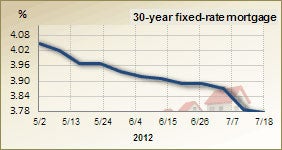
30 year fixed rate mortgage – 3 month trend
The benchmark 30-year fixed-rate mortgage fell to 3.78 percent from 3.79 percent, according to the Bankrate.com national survey of large lenders. The mortgages in this week's survey had an average total of 0.43 discount and origination points. One year ago, the mortgage index stood at 4.68 percent; four weeks ago, it was 3.89 percent.
This is the lowest the 30-year fixed has reached in the history of Bankrate's survey. The rate has not increased in the weekly survey since April 4.
The benchmark 15-year fixed-rate mortgage fell to 3.04 percent from 3.05 percent, while the benchmark 5/1 adjustable-rate mortgage fell to 2.89 percent from 2.95 percent.

Weekly national mortgage survey

Results of  avg. rates as of July 18, 2012, weekly national survey of large lenders and the effect on monthly payments for a $165,000 loan:

30-year fixed15-year fixed5-year ARM
This week's rate:3.78%3.04%2.89%
Change from last week:-0.01-0.01-0.06
Monthly payment:$766.95$1,142.64$685.90
Change from last week:-$0.94-$0.79-$5.31
At such low levels, even homeowners who refinanced a few months ago are starting to wonder if they can grab a better deal now, says Michael Becker, a mortgage banker at WCS Funding in Baltimore.
Becker says he has been swamped with calls from refinancers, and many of them are from clients that refinanced in the past year or so.

A lot of people who probably thought they were done are calling again. I'm fielding calls at 9 (p.m.), 10 p.m., and I take them because you never know when this is going to stop.The volume of mortgage applications increased about 17 percent last week from a week earlier, according to the Mortgage Bankers Association weekly survey. Refinances accounted for more than 80 percent of total applications.


How long will the party last?

Rates eventually will rise, but many mortgage experts say they don't expect a major spike anytime soon.
As long as the European debt crisis remains unresolved and until the economy in the United States shows solid growth, rates should stay near or at bottom.
What would cause rates to go up? Good news out of Europe -- I don't see that happening -- or unemployment going down -- I don't see that happening.
The U.S. economy has started to recover, but it's still far from healthy. Federal Reserve Chairman Ben Bernanke reminded Congress of that in a speech this week. "After running at nearly 200,000 per month during the fourth and first quarters, the average increase in payroll employment shrank to 75,000 per month during the second quarter," Bernanke said.


Europe still helping rates

Tension in the European financial markets should continue to favor mortgage rates in the United States. Investors are nervous about the euro crisis and want a safe investment in which to park their money. And despite the economic issues in the United States, U.S. Treasury bonds are viewed as a safe haven. High demand for Treasury and mortgage bonds is normally good for low rates.


Sunday, July 22, 2012

Foreclosures may be back on the upswing - cont.

Impact on the housing market
Properties that enter foreclosure still take some time to complete the process, however. In the second quarter, foreclosures took an average of 378 days — the longest time since 2007 — to move from the initial notice to the completed foreclosure, up from 370 days in the first quarter. (Bing: Get help avoiding foreclosure)

In several judicial-foreclosure states with the biggest backlog of foreclosures, such as New York and New Jersey, the time to completion actually decreased slightly.

Once banks took back a property, it took an average of 195 days from the date of foreclosure to sell, RealtyTrac said, up from 178 days in the first quarter. Properties with delinquent loans that sold before the foreclosure was complete — namely, short sales — took an average of 319 days to sell from the time of the first notice, up from 306 days in the first quarter.

Another wave of distressed properties is expected to hit the market by the fourth quarter, when the market is typically slow. This distressed inventory will dampen prices, though not by much, given the investor demand for these homes and the large number of expected short sales, which typically sell for more than real-estate-owned properties.

It is expected that home prices will fall 1% this year and rise 1% next year. We are not home free [with the recovery] yet. Blomquist and others say it's a healthy thing for these distressed properties, which have hung over the housing market, to be added to the available inventory now, especially given the short supply in many areas.